- English
- Español
- Português
- русский
- Français
- 日本語
- Deutsch
- tiếng Việt
- Italiano
- Nederlands
- ภาษาไทย
- Polski
- 한국어
- Svenska
- magyar
- Malay
- বাংলা ভাষার
- Dansk
- Suomi
- हिन्दी
- Pilipino
- Türkçe
- Gaeilge
- العربية
- Indonesia
- Norsk
- تمل
- český
- ελληνικά
- український
- Javanese
- فارسی
- தமிழ்
- తెలుగు
- नेपाली
- Burmese
- български
- ລາວ
- Latine
- Қазақша
- Euskal
- Azərbaycan
- Slovenský jazyk
- Македонски
- Lietuvos
- Eesti Keel
- Română
- Slovenski
- मराठी
- Srpski језик

How to Choose a 3D Welding Table?
As a core tooling component in welding/grinding operations, the stability, flexibility, and durability of a 3D welding table directly impact welding accuracy, work efficiency, and safety.
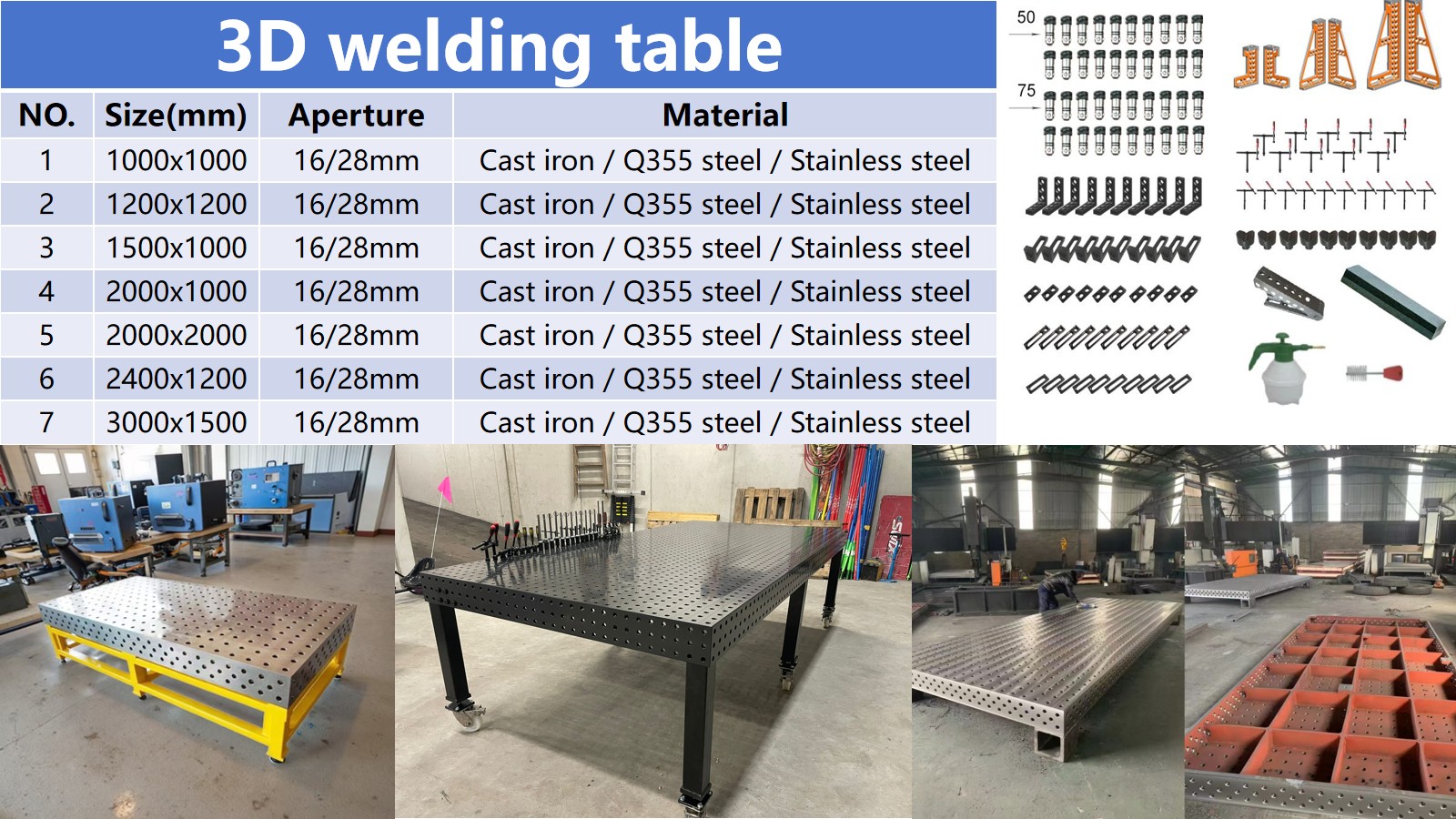
Botou Xintian Environmental Protection Equipment Co., Ltd. provides the answers.
Beginner's Guide and Professional Purchasing Needs:
I. Clarify Core Needs: Avoid Blind Selection
Work Scale
Small Workshops/Repair: Choose a basic model with a 16mm table hole diameter, customizable size, and a load capacity of 500-1000kg to meet sporadic welding and small-part processing needs.
Mass Production/Heavy Workpieces: Choose a heavy-duty model with a 28mm table hole diameter, customizable size, and a load capacity of 1500-3000kg to suit large structural components and multi-station collaborative operations.
Usage Environment
Indoor Workshop (Dry Environment): Conventional cast iron is sufficient, offering high cost-effectiveness.
Outdoor/Humid/High-Dust Environments (e.g., construction sites, mine repair): Prioritize stainless steel or nitrided steel for rust and corrosion prevention, extending service life.
II. Key Parameter Selection: From "Usable" to "Effective"
1. Tabletop Design: Core Functional Carrier
Material:
Preferred material: Q355 carbon steel (high strength, high temperature resistance, not easily deformed during welding);
For corrosion resistance, 304/316 stainless steel (higher cost, suitable for special industries).
Tabletop Thickness:
D16 Basic Model: 12-15mm (suitable for light loads and low-frequency use);
D28 Heavy-Duty Model: 22-26mm (tabletop less prone to deformation, more stable load-bearing capacity, and no decrease in accuracy over long-term use).
2. Accessory Compatibility: Enhancing Operational Flexibility
Essential Accessory Compatibility: Positioning pins, quick clamps, angle gauges, V-blocks, magnetic suction cups, etc. (Confirm that the tabletop hole positions match the accessory specifications to avoid installation problems);
Extended Functionality: Does it support splicing (multiple tables can be used together to accommodate extra-long workpieces)? Are there pre-drilled lifting holes (for easy movement)? 3. Safety Performance
Tabletop Edges: Chamfered (no sharp burrs to avoid scratches);
Load-Bearing Capacity: Actual load-bearing capacity must be ≥ 1.2 times the design load-bearing capacity (with a safety margin to prevent overload deformation);
4. Common Purchasing Misconceptions
Ignoring Material: Low-priced tables may use thin steel plates (≤10mm) or inferior steel, which are prone to deformation during welding, requiring short-term replacement and incurring higher long-term costs;
Pursuing Large Sizes: Overly large tabletops with insufficient load-bearing capacity can lead to decreased stability; selection should be based on the actual workpiece size;
Ignoring Accessory Compatibility: Some brands have unique hole specifications, making it difficult to find compatible positioning pins and clamps later, limiting usage scenarios。